Friday, January 11, 2013

How the mighty have fallen

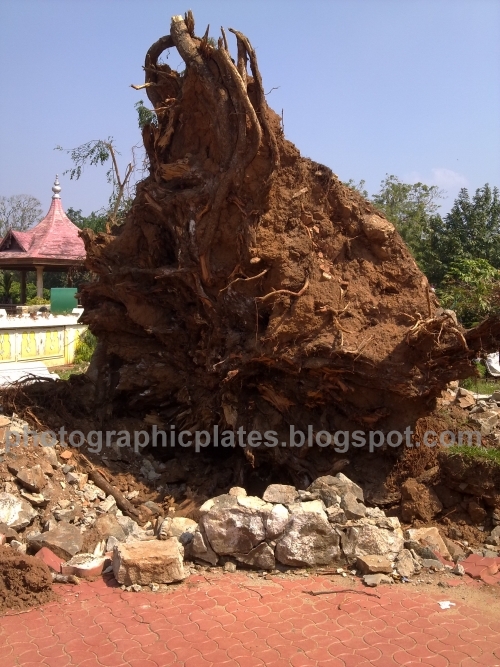
The nearly 200 years old and more than 20 meters tall Arayaal Maram ( usually found in temples , kavu etc) located to the right side of the Napier Museum building as shown in the pics fell down on a monday in the dry,rainless December Month of 2012  . Just like the failed North-East Monsoons of this year this ancient tree also gave up and crashed with a blood-curdling roar during the late hours of the afternoon . Luckily other than a few park benches , masonry works etc there was no human casualty  . The concrete circle that was recently constructed around the old tree played a major role in weakening its roots that resulted in this tragedy . Sadly a mute witness to the history of the city and the vagaries of time has also bid adieu .


Ruins of the once awesome KWA Swimming Pool


These pics are the testament of the deplorable current condition of the Kerala Water Works Swimming Pool at Vellayambalam in Thiruvananthapuram . The once flourishing swimming pool was dug up for renovating it for the 14th National Games proposed to be conducted in Trivandrum . But the bad planning of the engineers and politicians ensured that the end result is this mess . They finally constructed a new swimming complex at Pirappancode in the rural Venjaramood region nearly 30-40 Km from the city by spending crores of rupees and probably pocketing crores of bribes themselves for the new project . 


Tuesday, January 1, 2013

Azhimala Rockcut Temple

The Azhimala Rockcut temple located near Vizhinjam in Trivandrum is one with an immense historical significance ,but whose importance and uniqueness isn't well known to the general public at large . This temple is one of the only two rock cut temples currently known in southern Kerala the other being the Madavoorpara temple also in Trivandrum district . This temple was constructed by the Ay Kings who originally ruled the Venad Kingdom before the establishment of the current Kulashekara Dynasty by the Southern branch of the Kolathiri Family of Kannur. The place name itself suggests that the hill on which it stands was the head quarters of the Ay Dynasty - Azhi -Mala ("Hill of Ay").
There were reports in newspapers about the discovery of ruins of fort and recovery of burnt ships from the Vizhinjam Harbour that could possibly have been as a result of the well documented  Chola Invasion of Kandalur War.  

This is a centrally protected monument under the control of Archaeological Survey of India since 1965.
Tri-lingual signboard of ASI

Path leading from the Vizhinjam road to the shrine

The temple which seems to be incomplete (possibly due to some Chola/Pandyan Invasion) consists of a cell  having an independent seated idol of Dakshinamurthi that is datable to 8th century AD .The two sides of the cell have the sculptures of Tripurantaka and Shiva as Nataraja with Parvati standing close to him.
Façade of the shrine

Tripurantaka Sculpture

Tripurantaka carrying a bow and arrow in two of his four hands is a fine example of the 8th century sculptural art . His left foot rests on Apasmara , the crown of hair elegantly carved as a high head dress and is highly ornate .It is interesting that different forms of  Tripurantaka had evolved at such an early stage . This representation is a precursor of a similar type in metal during the time of Rajaraja- I . 

Unidentified possible Yakshas or Yakshini figurines at the pedestal of the Tripurantaka  sculpture

the incomplete Shiva and Parvati figurines on the right flank of the central cell.

"Key Hole"

Dakshinamurthy

remnants of the unfinished project

side view of the rock

back of the rock


Tuesday, September 11, 2012

Puthen ("Kuthira") Malika Palace


Puthen Malika Palace (Malayalam: പുത്തന്‍ മാളിക കൊട്ടാരം), most popularly known as Kuthira Malika (Mansion of Horses), is a palace built by Swathi Thirunal Rama Varma, on the south-eastern side of Padmanabhaswamy temple in Thiruvananthapuram.


Distant view of "Methan Mani" -- on the northern edge overlooking the  Padmatheertham Pond.
"Methan Mani" was commissioned by the Maharajas of Travancore("Thiruvithaamkoor") to commemorate the victory of the numerically and technologically inferior Travancore Army over the French trained modern forces of Tipu Sultan of Mysore at the Battle of Nedumkotta in 1789 . It has the head of a bearded man being rammed on both cheeks by a pair of mechanical goats at every hour . It had stooped functioning and hasn't been repaired since.
Close up of the "Methan Mani"


View of Gopuram of Padmanabha Swamy Temple through the grills of the Kuthira malika Palace.


Western side of the palace that is out of bounds to tourists 


Stone columns supporting wooden balcony


Another view of the western side of palace of Swathi Thirunal


Old royal baby cot


Kathakali Mannequin


Marble idols of Lord Vishnu, lord Krishna,Lord Narasimhamoorthy


Elegantly carved and embellished wooden statues of Sri Rama and Lord Hanuman 


Exquisitively carved wooden ceilings with Lotus Design


Ancient Travancore Shield made of rhino hide


Weapons of war that defeated Tipu Sultan


Mask of a Yaksha of Nepali origin .


View of Padmanabha Swamy Temple from the palace windows


Place where dances were performed for the eyes of the king


Narrow corridors of power traversed by the Kings of a realm.


Yet another splendidly carved roof of a room


Who all have walked through here?


View of the other smaller buildings of the palace complex that have not yet been opened  up for the public.


Royal bed


Travancore imperial assembly


Belgian Crystal Chandeliers


Chinese Porcelain ware possibly from Qing Dynasty China.


Chinese porcelain Dragon


Old matchlock used in wars against Zamorin , Tipu Sultan and  Britain.


Ancient metal spears.


Courtyard of the palace.
The palace gets its name from the 122 horses that are carved into the wooden wall brackets that support the southern roof. The official name of the palace is Puthen Malika (New Mansion). The palace forms part of a vast complex of royal buildings in the vicinity of Padmanabhaswamy Temple. The building was left unoccupied for more than a century, following the demise of Swathi Thirunal in 1846.
A portion of Kuthira Malika has been converted to a Palace Museum that houses some of the assets owned by the Travancore Royal Family. The collection includes Kathakali mannequins, Belgian mirrors, crystal chandeliers, paintings, armaments, musical instruments, traditional furniture and other artifacts. On the right side of the mannequins are the ivory cradles of various sizes. The palace has on display two royal thrones, one made of ivory and the other of Bohemian crystal with the Tranvancore emblem 'conch' adorning the top of the backrest. The palace has a large collection of idols and sculptures made from white marble.
On the first floor are rooms that once served as the audience chamber, the library and an alcove that Swathi Thirunal used for meditating and for conceiving many of his famous musical compositions. This place offers a direct view of the Padmanabhaswamy temple gopuram. One of the rooms displays an illusion portraint of Sree Chithira Thirunal Balarama Varma, painted by Svetoslav Roerich. The face and the shoes of the king appear facing the onlooker from every corner of the room.

The palace was abandoned quite soon after its inauguration as the  south ward looking main entrance of the palace was considered bad under the rules of Vaastu Shaastra . The King lived here for less than  two months . It has remained unoccupied ever since in pristine condition.